Case study · Property Finder · 2026
Agencies lost their consultants. I built the renewal system that replaces them, and the engine that lets it scale.
We expected agencies to want flexible, customisable plans. As the market stabilised, they wanted to renew quickly and with confidence. This is how that shift reshaped the product, and the funnel.
of agencies who open their renewal plans now choose one
of agencies who choose a plan go on to sign
values to reconcile on the recommended plan
Role
Senior Product Designer, design lead
Team
PM · Engineering · Commercial
Timeline
2026 · launch Q2, redesign Q3
Status
Live, designed for 5 markets
The story in 60 seconds
- Problem
- Consultant coverage for agencies spending under AED 24K a year was withdrawn during the regional conflict. They had to commit a year’s budget unassisted, on a screen where the offer was split across stacked discounts.
- The pivot
- Client conversations suggested customisable plans would drive engagement. As the market stabilised, agencies cared less about flexibility and more about finishing quickly; only 2 in 6 built their own plan. So we shifted to reducing friction.
- Key decisions
- Built the commercial back-office (Contract Engine) before adding screens. Kept exclusivity nudges within plan selection, behind a dedicated consent step. Led with a recommended plan, with Build your own replacing the consultant callback.
- Trade-off
- Plan selection carries one additional consideration, so the value of exclusivity can be compared across plans.
- Result
- Plan selection rose from 46% to 80% of agencies who open their renewal plans, and from 20% to 78% of those go on to sign. Shown as rates, because the pool of eligible agencies changes every month.
The shift
From calculating an offer to choosing a plan

- –Values on the recommended plan reduced from 9 to 3; offer rules per plan from up to four to one.
- –The current contract is shown above all options as a reference point.
- –The consultant callback was replaced with a self-built plan, priced in real time.
Context
Renewals depended on a consultant
PF Expert is where real estate agencies manage their listings and their yearly contract with Property Finder. They buy credits each month and spend them to publish and promote listings, so renewals drive recurring revenue. When a contract ended, a business consultant guided the agency through the renewal. The renewal screen itself ended with “Your Business Consultant will reach out to you as soon as possible.”
How a renewal used to work
When the regional conflict began, smaller agencies came under significant financial pressure, and some closed. Consultant coverage for agencies spending under AED 24K a year was withdrawn, leaving them to commit a year’s budget on a screen that had been designed to be explained by a person.
Where I came in
I joined Property Finder at this point, and inherited the design below.
A relief version had been launched quickly to put support offers in front of agencies, against a target of 20% of renewals completed without assistance. Below is an interactive recreation of that screen, including the breakdown behind “Learn more”.
Self-serve completion reached 9%, against a 20% target.
More than half of agencies left before choosing a plan, and four in five of those who did choose one never signed. They weren’t rejecting the offer; they were struggling to work it out. A relief offer applied for three months, an early-renewal bonus and an exclusive bonus each applied for twelve, and the totals sat in a separate table.
“If the recommendation is good, I’ll act on it. I want to understand what’s right for my business.”
The constraints
- –Every offer was hard-coded into the screens, so each new offer meant a design and engineering rework.
- –No researcher was available, so I ran research myself while supporting two squads.
- –The performance data needed for personalised recommendations wasn’t available that quarter.
- –The same flow had to work in five markets, from AED to QAR with VAT.
The tension
Commercial was used to shaping each offer freely, so a structured model felt like a loss of control. But every bespoke offer required a design ticket, an engineering build and another rule for agencies to interpret. The flexibility Commercial valued was the main obstacle to scale.
Workshop
Aligning on what to automate before designing
Before any design work, I ran an internal workshop with Commercial, Engineering and Product, the teams accountable for renewals. The objective was to establish how far we could reduce human intervention, and to agree where a person still added value. We worked through four “How might we” questions, generated more than 50 ideas and prioritised four by vote.

Automated versus human-assisted
- Automated
- Renewals and auto-renewals, upgrades and top-ups, AI suggestions, new business sign-up, onboarding, returning clients and credit carry-forward.
- Human-assisted
- Payment issues, contract termination and downgrades, temporary account holds, replacement contracts, parent-to-child account mapping.
Upgrade signals the platform already holds
The signals a consultant relied on to open a renewal or upgrade conversation were already in the platform. The system could read them directly:
Credits running out faster than the plan replenishes them.
Listing count rising against the previous period.
New agents added to the account.
Moving into new areas or property types.
Past return on higher spend suggests more credits will pay off.
New roles and requirements in the journey
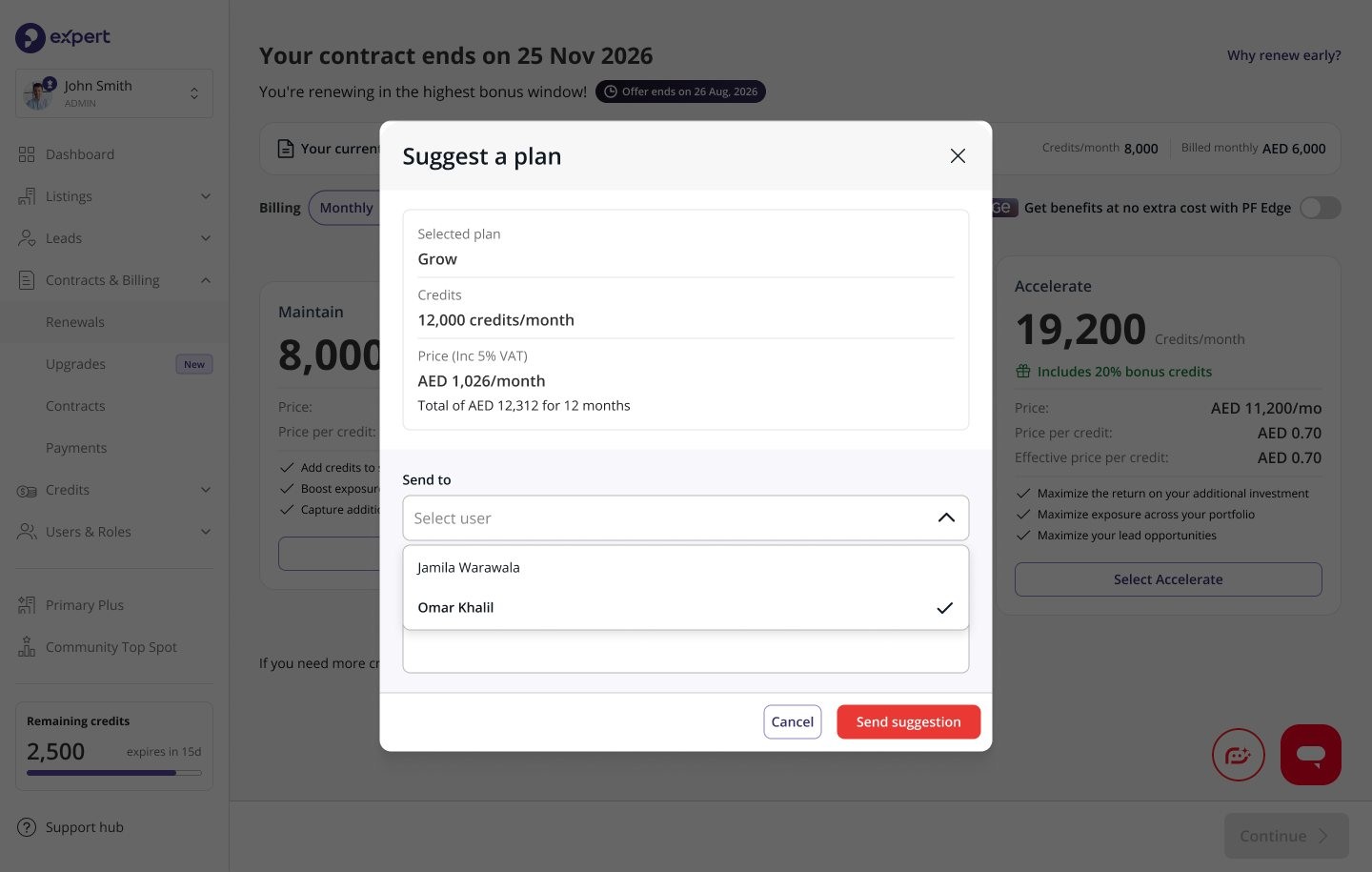
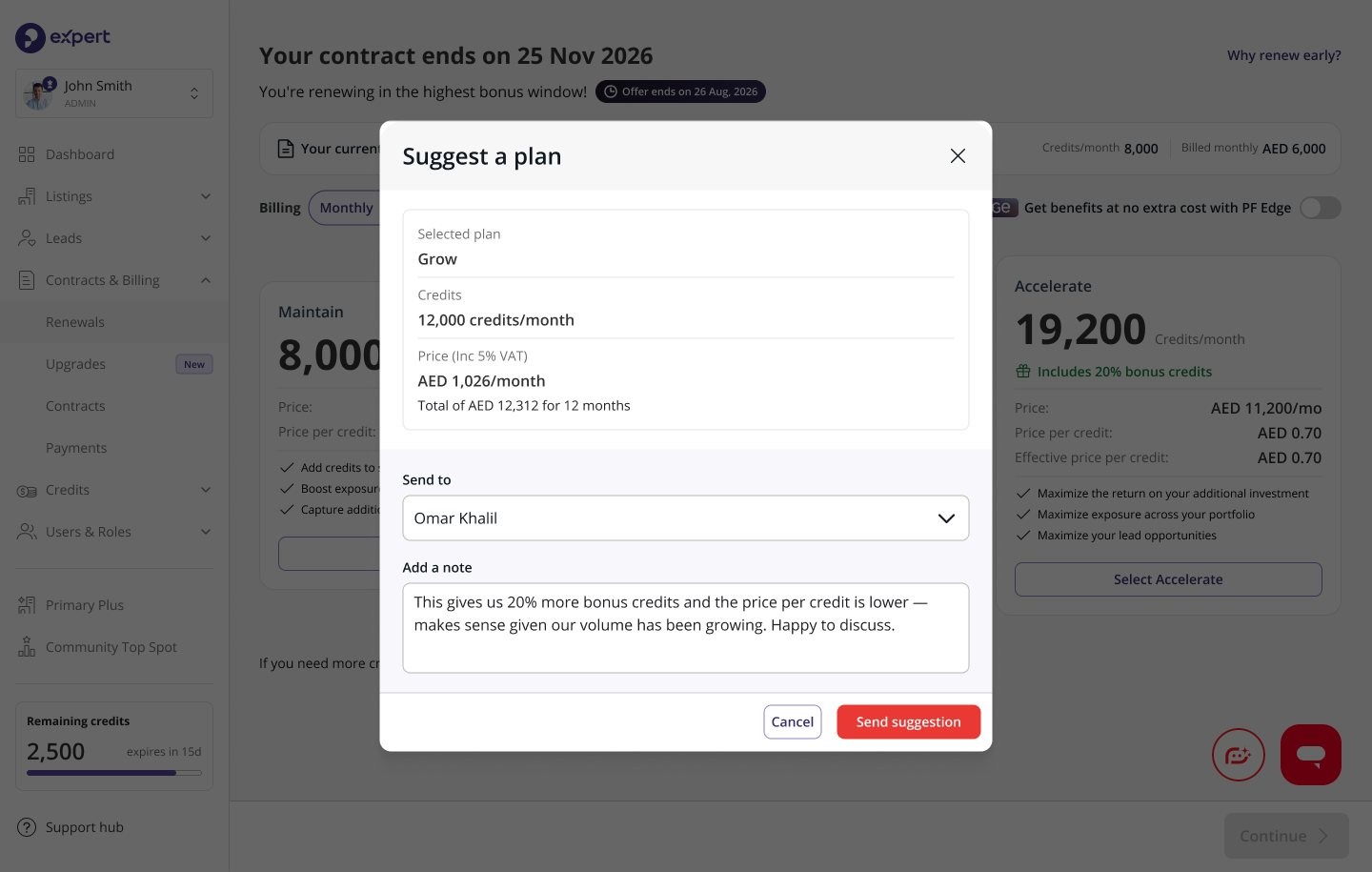
Without a consultant, the user’s role became significant. Decision makers can sign and renew; admins cannot. I introduced a path for admins to recommend a plan, so the same journey ends in a purchase for decision makers and a recommendation for admins. Stakeholders also asked for every bonus and discount to be displayed.
Can sign
Can’t sign
Where I pushed back
Adding all of this risked recreating the original problem, with agencies left to reconcile figures. I pushed to streamline the information and reduce the number of variables:
- –Every plan uses the same, or closely comparable, variables, so plans can be compared at a glance.
- –Consistent plans allow one to be promoted as the recommendation, based on the client’s history.
- –Bonuses and discounts are limited to one line per plan; the full breakdown appears just before signing.
Workshop outputs
Each “How might we” question was explored on its own board. The notes are the team’s contributions; the key themes are my synthesis.


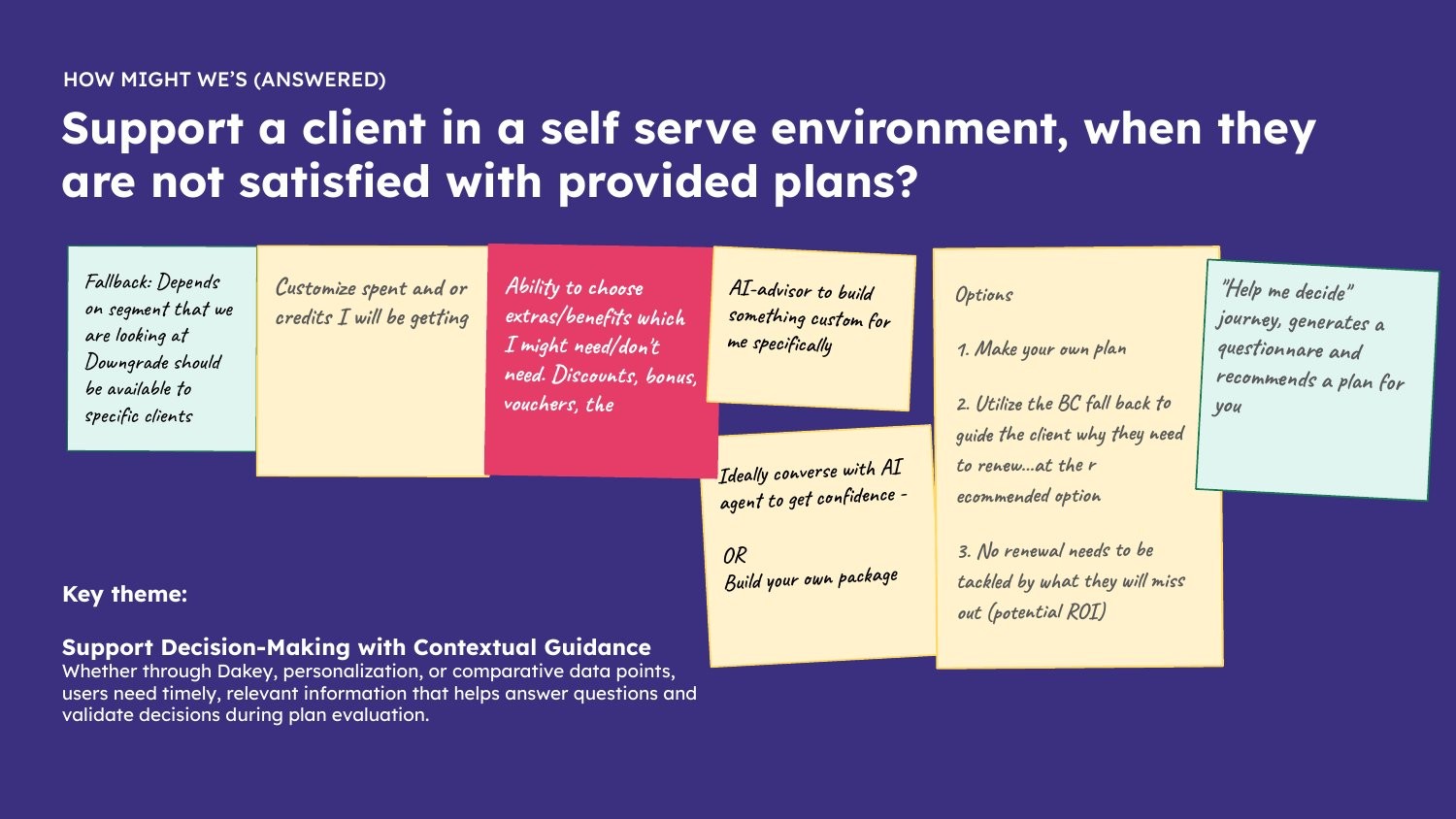

Prioritised ideas
01
Reduce variables and simplify plans
Plans defined by credits per month, with nothing further to interpret.
02
Self-built plans
Control for agencies that need a different configuration.
03
Data-informed recommendations
Recommendations explained using the agency’s own data.
The fourth, a burn-rate upgrade prompt, reframes a retention risk as a growth opportunity. It shipped as part of Upgrades.
“The platform already knows. It just doesn’t say.”
The pivot
We bet on flexibility. Agencies wanted to finish.
Our first hypothesis came from client conversations during the conflict. Agencies under financial pressure told us they wanted to reshape their spend, so we expected customisable plans to drive engagement, and treated Build your own as a headline feature.
- Hypothesis
- Customisable plans would drive engagement. Agencies under pressure would want to build their own renewal rather than repeat last year’s package.
- What changed
- As the market stabilised, agencies cared less about flexibility and more about completing the renewal quickly and with confidence. In testing, only 2 in 6 agencies used Build your own; the other 4 chose the plan we recommended.
- New direction
- Reduce friction instead of adding choice. Lead with one recommended plan, give every plan the same few variables, move the detail to just before signing, and keep Build your own as the answer when nothing fits.
That shift shaped every decision that follows, and it shows in the funnel: the biggest gains came at the stages where agencies used to stop and calculate.
Decisions
Two decisions that shaped the redesign
Decision 01
Address the root cause: build a contract engine.
- What I inherited
- A design that was not built to scale. Offers were hard-coded into the screens, and the relief plan card carried nine values and four offer rules. Its “AED 2 per credit” label did not reflect the actual price of approximately AED 1.68.
- Getting to the root
- To make renewals scalable and reliable, I worked back to the source of the offers: how Commercial made pricing decisions. With that understood, my PM, EM and I agreed to build a contract engine able to absorb ongoing changes to renewals. Given the role renewals play in recurring revenue, we were not prepared to compromise on it.
- Alternative
- Keep designing each offer into the screens, as the relief launch did.
- Trade-off
- Commercial gave up free-form offers. I designed the Contract Engine admin with Commercial as its primary users, so the structure gave them speed rather than taking away control. They now own package values and customer groups.
How Contract Engine shapes the screen
Contract Engine
Commercial configures
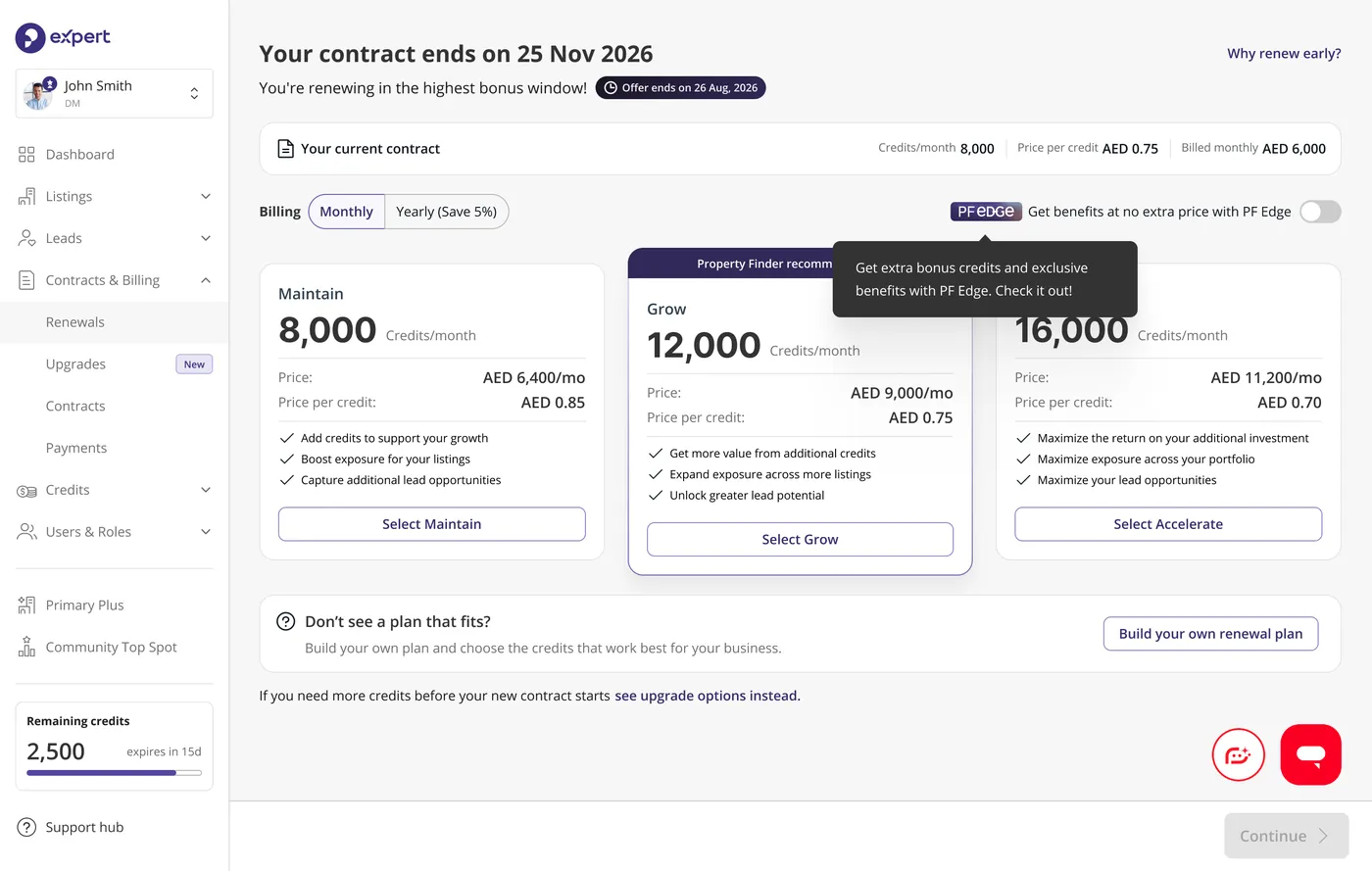
Maintain, Grow, Accelerate and the upgrade tiers. Each has one credit increase and at most one bonus or discount, so every plan card carries the same variables.
PF Expert renewal screen
The agency sees
Try it: change a customer group’s package
What the agency sees
The renewal screen renders from the matched group’s package. Edit the package and the plan updates; no design or engineering ticket.
Decision 02
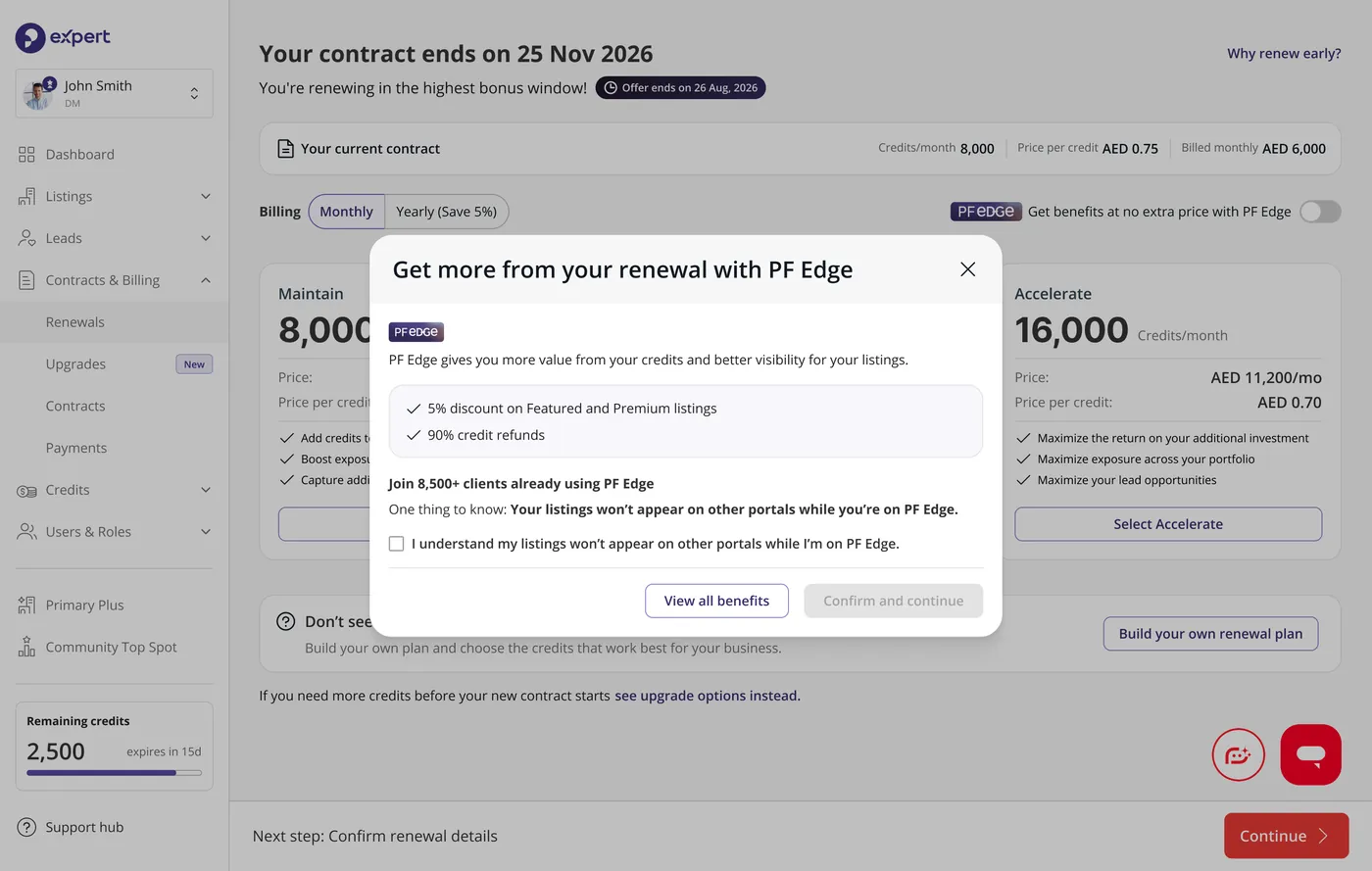
Keep PF Edge in plan selection, behind its own consent step.
- Alternative
- Move PF Edge to a later step, after plan selection. This was my initial preference, as it simplified the first decision.
- Evidence
- PF Edge changes the plan and its benefits, and only at selection could agencies compare its value across all three plans. In research, no admin was willing to enable exclusivity without understanding it.
- Trade-off
- It adds a consideration at the point of choice. In return, its value remains visible, and the one decision with significant consequences, listings leaving other portals, requires deliberate confirmation.
How an admin recommends a plan
Admins can compare plans but can’t sign. From the same renewal screen, they choose a plan and send it to a decision maker on the account with a note. The decision maker sees it first when they open renewals, and can continue with it or choose differently.



What shipped
Less to work out at every step
When no plan fits
Agencies whose needs did not match any plan were the clearest test of self-serve, and the point where earlier versions relied most on a consultant. Each version of the screen handled that case differently.
Before relief
Q1 2026
A full column directing the agency to request a call back from their consultant.
Need another option?
If you can’t find what you are looking for, you can request a call back.
Your Business Consultant will reach out to you as soon as possible to discuss further.
Request a call backRelief launch
Q2 2026
Reduced to a banner, but still dependent on a consultant many agencies no longer had.
Request a callbackNeed another option?
If you can’t find what you are looking for, request a callback and your Business Consultant will be in touch.
My redesign, live
Q3 2026
The agency configures its own plan and sees the price immediately.
?Build your own renewal planDon’t see a plan that fits?
Build your own plan and choose the credits that work best for your business.
A callback remains available as a fallback, but the primary path is now self-serve.
Five changes to reduce effort at the point of decision
- 1 of 5Comparable plansMaintain, Grow and Accelerate show price and price per credit side by side, with at most one bonus line, so relative value is clear.Addresses the clarity gap.
- 2 of 5Visible urgencyA generic “act now” banner became a tiered incentive: 15% at 150 days, 10% at 90 and 5% under 30, with the agency’s current position marked.Same incentive, clearly communicated.
- 3 of 5An option when no plan fitsAgencies enter the credits they need and the price updates. It serves the minority who want control, without a callback.2 in 6 agencies used it in testing; the rest chose the recommendation.
- 4 of 5Friction where it is warrantedAgencies would not opt into exclusivity without understanding it. PF Edge has a dedicated step, a plain-language trade-off and a required acknowledgement.Research finding 3.
- 5 of 5Full transparency before signingMonthly credits, invoices and required documents are presented immediately before signature.The detail from the former “Learn more” pop-up, shown at the relevant moment.
Prototype
The live flow
An interactive recreation of the live flow. Explore PF Edge, configure a custom plan, or attempt a downgrade to see the handoff.
One self-serve journey, with one deliberate handoff
Every path runs from plan selection to signed contract without assistance. PF Edge is an optional step with its own consent. The only handoff to a person is a downgrade, by design.
Downgrades initiated from Build your own are routed to a consultant.
Upgrades
Growing between renewals, on the same model
Upgrades let an agency add credits mid-contract instead of waiting a year. Because offers already lived in Contract Engine, upgrades launched in Q3 on the same packages and patterns as renewals. No new offer logic, and nothing new for agencies to learn.
Admins told us they care about what an upgrade delivers, not its size as a percentage. Build your own already uses credits and AED; the fixed tiers still lead with “Upgrade by 10%”. Reframing them around outcomes is the next iteration.
How I worked
Research every cycle, alignment before build
Exploring before committing
I explored three ways an agency could choose a plan, then recommended a hybrid: recommended plans as the primary path, a self-built plan as the alternative, and a single consistent checkout.


Research, and how I used AI
I ran 10 client sessions myself across Emerald and Sapphire agencies. I used AI to cluster session notes into themes, then reviewed and refined them myself, and built working simulations to test on live calls, so agencies responded to real pricing rather than static mock-ups. The research produced six findings, each with a design response. Decisions on which findings to act on, and what to gate, remained mine.

The most significant finding reframed the brief: agencies could use the product; what they lacked was confidence in the offer. The findings and responses are below.
#
Finding
Design response
Status
Ownership
- Me
- Every renewal and upgrade screen and state, the PF Edge journey, five market variants, the Contract Engine admin structure, and all 10 research sessions.
- The team
- The PM owns the business framing. Engineering built Contract Engine and the flows. Commercial owns package values and country terms. Consultants keep downgrades and other high-stakes cases.
Outcomes
Results and attribution
Since the conflict quarter, conversion has grown steadily at every stage of the renewal journey. The largest change came after plan selection: agencies who choose a plan now go on to sign.
Understanding the renewal funnel and measurement approach
Unlike a traditional conversion funnel, the renewal journey operates on a rolling eligibility window. Agencies become eligible at different points, as their contracts approach renewal, so the number entering the journey changes month on month. A fixed customer base would misrepresent it.
To keep comparisons consistent, I use a standardised cohort of 1,000 eligible agencies to illustrate the conversion rate at each stage. The rates come from our analytics; the cohort size is for illustration only.
Of those at the step before
Of those at the step before
- What I claim
- In a standardised cohort of 1,000 eligible agencies, plan selection rose from 460 to 800 and signed renewals from 90 to 620, and the improvement has held since. The redesign removed the steps where agencies had to stop and calculate.
- What I don’t
- The market stabilised over the same period, which helped. And because the renewal pool changes every month, I report stage ratios, not absolute volumes.
What’s next
Showing each agency what matters to them
Contract Engine already puts every agency in a customer group, by market, segment and client type, and each group gets its own offer. The next step is to use what the platform knows to explain the recommendation itself.

The assumption we’re moving on
Agencies will act on a recommendation when it’s explained with their own data.
- Why this one
- Agencies missed the “Why is Property Finder suggesting this?” prompt, and an Emerald admin called her rep for reassurance she didn’t need. The gap is confidence, not usability.
- What we’re building
- The suggested plan beside today’s contract, with the reason in the agency’s own signals: credit usage, listing growth, agent growth and community growth.
- How we’ll know
- Recommendation acceptance rate, and conversion from the renewal page to a chosen plan.
- Status
- Next, and the open gap. Business Analytics hasn’t yet defined why we recommend a given plan. Once they do, that reasoning goes into Contract Engine so each contract carries its own explanation, and the agency sees it beside the recommendation.
Also on the list
- Read the live results
- Report Emerald and Sapphire against their targets, with plan mix and overall renewal rate beside them.
- Bring the decision maker in
- Admins often need the owner’s approval. Let them share a renewal without leaving the platform.
- Validate the new markets
- My research covered the UAE only. Qatar, Bahrain, Saudi Arabia and Egypt each need their own sessions.
Reflection
What I’d do differently
I’d spend much more time understanding what else my clients use, from other portals to the other Property Finder products they already buy, and how we could stack Property Finder’s offering differently. The journey may not need to look like this at all.
With more time, I’d explore a stackable version of Build your own: the agency chooses a base plan with no benefits revealed, then adds benefits one at a time, seeing what each one adds. It’s a complex proposition, and Commercial has turned it down once. I’d still like to explore it.
Today
What I’d explore
I’d also agree how to measure every trade-off before it ships. We kept PF Edge in plan selection on purpose but never tracked how agencies responded to it, so Decision 02 is still a judgement, not a result.
What I’d keep
01
Clarity over volume.
Agencies did not need longer explanations; they needed fewer values to reconcile. Reduction was the core of the design work.
02
Use friction deliberately.
Removing friction everywhere would have been a mistake. The one decision with real consequences was given a deliberate pause.
03
Design the system, not only the screen.
Self-serve scales only if Commercial can change offers without design involvement, which meant designing their tool as well.